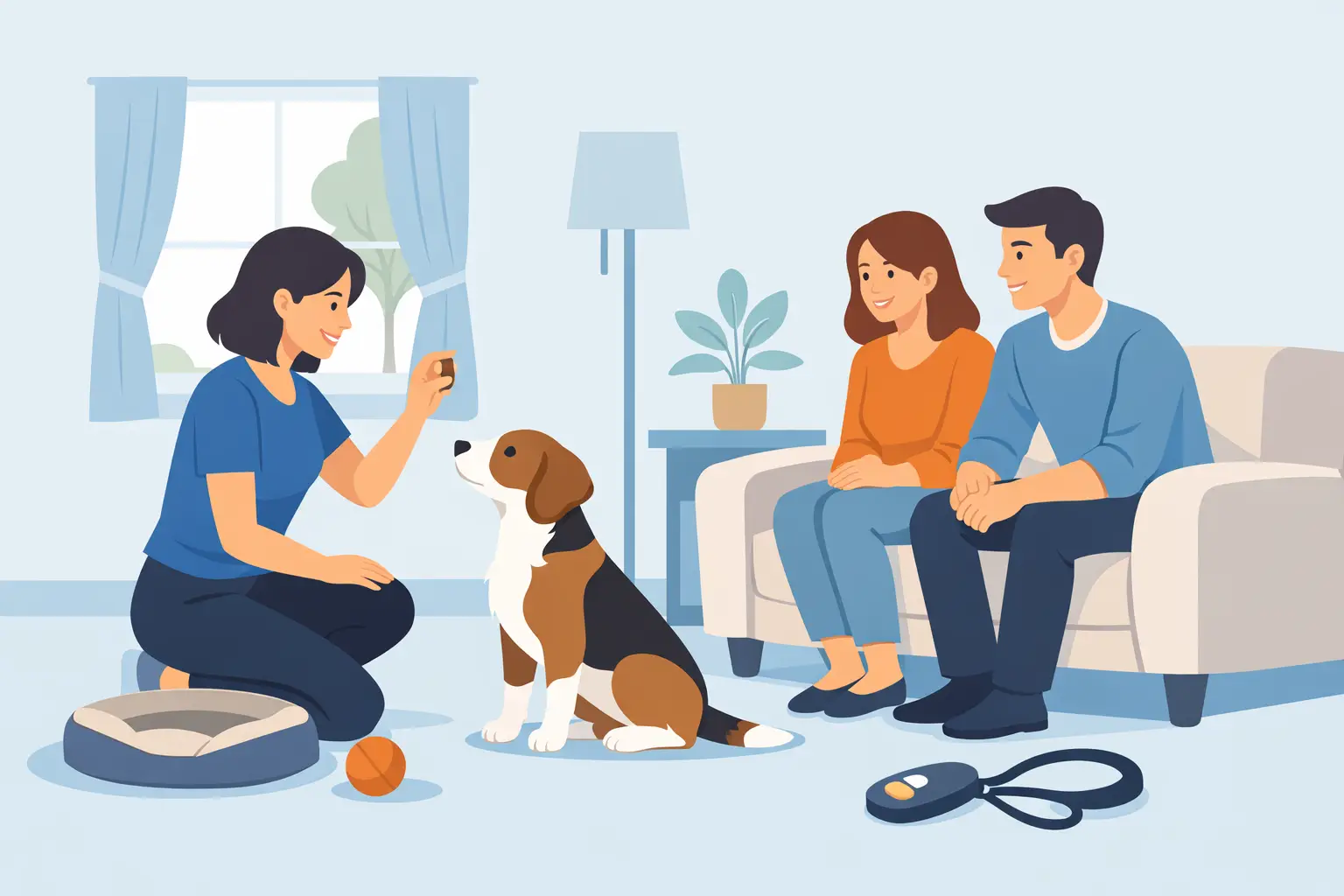
Your dog sits perfectly in a quiet class, then loses its mind when the doorbell rings, a guest walks in, or another dog appears on your street. That gap is exactly why people ask what is in home dog training. The short answer is simple: it is professional dog training done in the places where your dog actually lives, makes mistakes, and needs to listen.
That matters more than most owners realize. Dogs do not generalize behavior well. A dog that can hold a sit inside a facility may still ignore the same command in your kitchen, your driveway, or on a walk through your neighborhood. Real control has to be built where the behavior happens.
What Is In Home Dog Training?
In home dog training is one-on-one work with a professional trainer in your home and daily environment. Instead of bringing your dog into a generic group setting, the trainer comes to you and addresses the exact problems showing up in your real life.
That can mean leash pulling at the end of your block, charging the front door when guests arrive, barking through the windows, blowing off recall in the backyard, guarding space in the house, or turning reactive around other dogs on your normal walking route. The location is not a convenience feature. It is part of the training plan.
For many dogs, the home is where the biggest issues start. Thresholds, furniture boundaries, meal routines, crate behavior, visitor management, and household structure all shape obedience. If those pieces are weak, the dog carries that instability everywhere else.
What Is Included in In Home Dog Training?
The answer depends on the dog, but strong in-home training usually includes evaluation, obedience work, behavior modification, owner coaching, and proofing under real distractions.
The first step is not showing off commands. It is identifying what the dog is doing, why it is happening, and what is reinforcing it. Sometimes the issue looks like stubbornness but is really confusion. Sometimes it looks like anxiety but has turned into learned behavior. Sometimes the dog has been allowed to rehearse bad decisions for months, so the pattern is deeply rooted.
From there, the trainer builds control in practical areas. Inside the home, that often means place command, door manners, crate training, leash handling, structured greetings, and stopping unwanted behaviors like jumping, pacing, demand barking, or rushing visitors. Outside the home, it may expand to heel, recall, sit, down, extended duration, and calm behavior around dogs, people, traffic, and noise.
Good in-home training also trains the owner. That is a big part of the process and one reason results can hold up better. The dog is not just learning from the professional. You are learning timing, consistency, pressure, reward, and how to handle mistakes without creating chaos.
Why Training at Home Works Better for Many Dogs
A controlled facility has value. It can help build early reps with fewer distractions. But if your dog melts down at your front door, acts territorial in your living room, or drags you down your own street, a clean indoor training room is not where the real problem lives.
In-home training strips away that disconnect. The trainer sees the dog in its actual state, not its temporary class behavior. That means fewer guesses and faster corrections to the plan.
There is another advantage most owners miss. Your home contains the triggers, routines, and habits that shape your dog's behavior every day. The dog knows the windows it patrols, the couch it claims, the fence line it runs, and the hallway where it starts spinning up. Training in that environment exposes the truth quickly.
This is especially important with reactivity, aggression, territorial behavior, and household noncompliance. Context matters. If the dog only falls apart in specific situations, the training should address those situations directly.
What Problems Can In Home Dog Training Fix?
A lot, if the dog is getting the right program and the owner follows through.
Common issues include leash pulling, poor recall, jumping, barking, charging the door, not listening around distractions, crate problems, nervous behavior, resource guarding, dog reactivity, stranger issues, and household boundary problems. It is also a strong option for families that need the dog to behave around kids, visitors, delivery drivers, or busy daily routines.
That said, not every problem is solved the same way. A young dog with sloppy manners is different from an adult dog showing true aggression. A fearful dog needs different handling than a pushy, overconfident one. This is where experience matters. Cookie-cutter training misses those distinctions, and owners pay for it with slow progress or unreliable results.
What a Typical In-Home Session Looks Like
Most sessions are focused, not flashy. The trainer watches the dog move through normal situations, identifies weak points, then starts building better responses with clear structure.
One session may focus heavily on thresholds and door control because the dog explodes when someone enters. Another may center on loose-leash walking and engagement because the owner has no control outside. Another may work through household leadership issues that show up as pushiness, whining, refusal to settle, or selective listening.
The best sessions are not random. They stack skills in a way that creates usable control. First the dog learns what is expected. Then the dog learns to do it with consistency. Then the dog learns to do it around real distractions. That final step is where many training programs fall apart.
A serious trainer does not aim for obedience only in ideal conditions. The standard is performance when life gets noisy.
In Home Dog Training vs. Group Classes
Group classes can help with social exposure and basic reps, especially for easygoing dogs with minor obedience gaps. They are often more affordable, and for some owners that matters.
But group classes are limited by design. The trainer has to divide attention across multiple dogs, the curriculum is standardized, and many of the real household issues never show up there. Your dog may not challenge boundaries in a room full of strangers the same way it does when it hears someone at your front door at 8 p.m.
In-home work is more targeted. It is built around your dog, your layout, your routines, your pressure points, and your goals. If you need a dog that can hold obedience in your living room, on your neighborhood walk, and later at a crowded outdoor restaurant, the path should reflect that.
That is one reason Sin City K9 focuses so heavily on real-world behavior instead of classroom performance. Owners in Las Vegas and Henderson do not need a dog that listens only in training. They need a dog that listens where life actually happens.
Is In Home Dog Training Worth It?
If your dog's worst behavior happens at home or in your normal daily environment, yes, it usually is.
The value is not just convenience. The real value is precision. The trainer can see what is causing the behavior, coach you in the moment, and build obedience where you need it most. That often saves time compared with trying to transfer skills from one environment to another later.
The trade-off is that results depend on honesty and follow-through. In-home training exposes household habits fast. If family members are inconsistent, if rules change by the day, or if nobody practices between sessions, progress slows down. The training can be excellent and still fail if the handling at home stays sloppy.
That is not a drawback of the method. It is reality. Dogs live by repetition and consequence. They believe what happens every day.
Who Benefits Most From In Home Dog Training?
Owners dealing with real behavior problems usually benefit the most. That includes dogs that are reactive on walks, territorial in the house, unreliable around distractions, or difficult to manage in normal family life.
It is also a strong fit for busy households. If you do not have time to load up the dog, drive across town, and hope the lesson transfers back home, training at your location removes friction and keeps the work relevant.
Puppies can benefit too, especially when the goal is preventing bad patterns early. But in-home training is not just for puppies or basic manners. It is often where serious control starts for adolescent and adult dogs that have already learned how to ignore people.
What Results Should You Expect?
Expect progress you can measure, not magic by the end of one session.
A good program should create better obedience, cleaner household behavior, clearer communication, and more confidence handling your dog. You should see the dog start making better decisions, but you should also understand how to maintain those standards yourself.
Some dogs move fast. Others require more repetition, especially if they have a long history of rehearsed bad behavior, high drive, fear, or aggression. The point is not speed for its own sake. The point is reliable behavior under pressure.
That is the standard owners should care about. Not whether the dog looked good for five minutes in a quiet room, but whether it can hold commands when the door opens, when another dog passes, when guests come over, and when the environment stops being easy.
If your dog only listens in theory, you do not have obedience yet. You have a demo. Real training starts where excuses usually begin - at home.