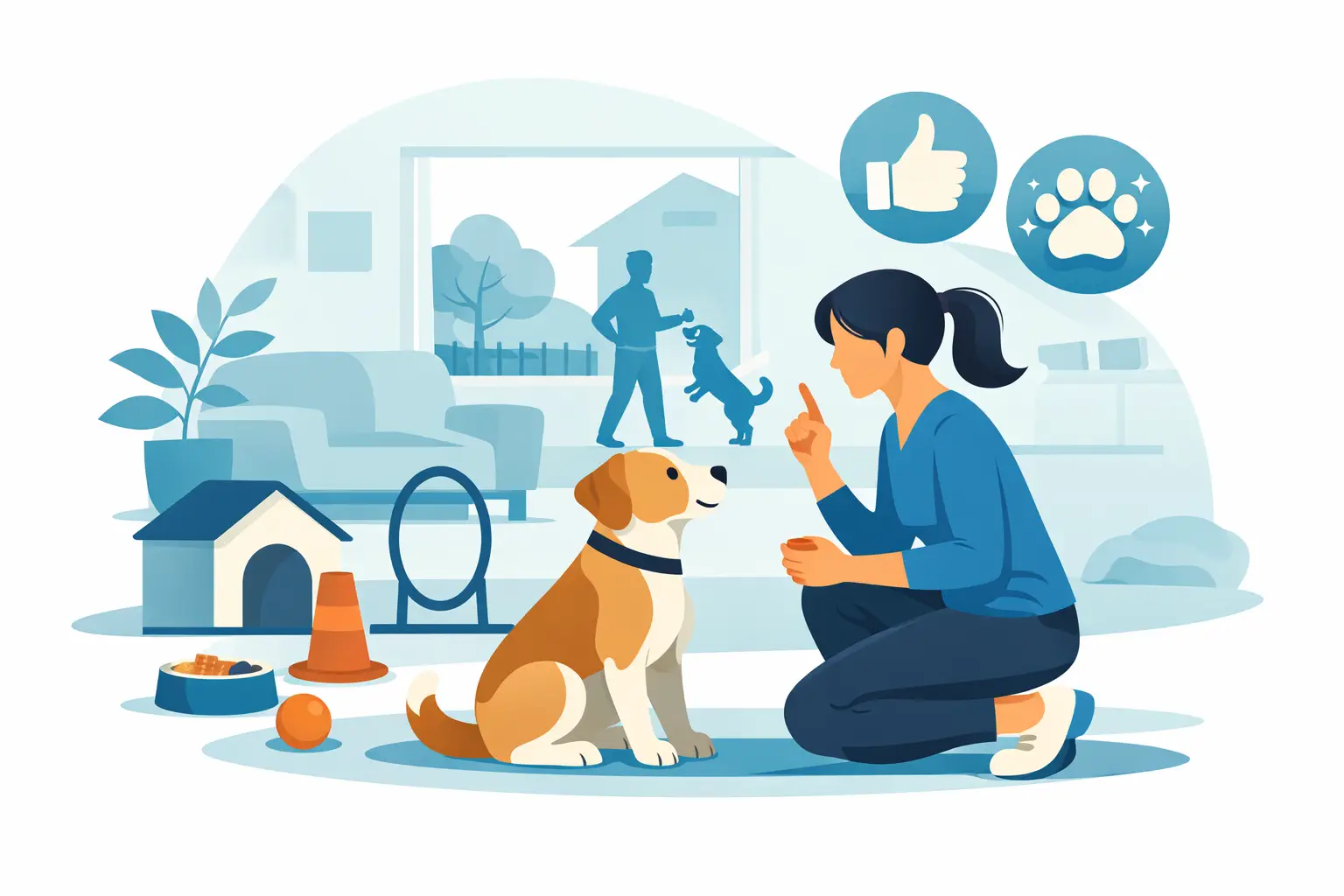
A dog that listens in the kitchen but falls apart at the front door is not trained. That is why the best home dog training program is not the one with the slickest videos or the biggest promise. It is the one that creates control where your dog actually struggles - in your house, on your sidewalk, around guests, near other dogs, and under real distraction.
Most owners are not dealing with a lack of information. They are dealing with a lack of reliable follow-through from the dog. The issue is rarely that your dog cannot sit in a quiet room. The issue is that your dog ignores you when the doorbell rings, drags you down the block, loses its mind around another dog, or blows off recall when something more interesting shows up. A serious training program has to address that reality.
What the best home dog training program actually does
A good program teaches commands. The best home dog training program builds behavior you can trust. Those are not the same thing.
Trustworthy training starts in the environment where the problem lives. If your dog charges the front door, training has to happen at the front door. If your dog is reactive on neighborhood walks, that behavior has to be worked on during neighborhood walks. If your dog is calm in the living room but chaotic in public, the training cannot stop at home just because the dog looks obedient in a controlled setting.
This matters because dogs do not generalize well on their own. A dog may understand place in one room and still break it when guests come over. A dog may heel nicely in a lesson and then pull with you the next morning. That does not always mean the dog is stubborn. It usually means the training was not proofed in enough situations, with enough consistency, and with clear accountability.
The strongest programs focus on three things at once: communication, consequence, and repetition under distraction. Communication tells the dog exactly what is expected. Consequence makes the expectation matter. Repetition under distraction is what makes it hold up in real life.
Why many at-home programs fail
There is no shortage of online plans, cheap video libraries, and one-size-fits-all obedience packages. Some are useful for basics. Few are enough for serious behavior problems.
The biggest weakness is lack of customization. A nervous rescue, a dominant adolescent working breed, and a dog with leash aggression do not need the same plan. If the program treats them like they do, progress usually stalls. Owners end up blaming themselves, when the real issue is that generic instruction cannot solve a specific behavior pattern.
The second problem is clean-room training. A dog may look great in a quiet lesson and still be unreliable when life gets messy. Real training has to include door manners, public exposure, neighborhood walks, strangers, dogs, food distractions, and the random pressure of everyday life.
The third issue is owner handling. The dog is only half the equation. If the owner cannot read timing, hold standards, and stay consistent, the results fade fast. The best program trains the human just as hard as the dog. It should leave you with a system you can use, not a temporary performance that only shows up during appointments.
How to judge the best home dog training program
Start by ignoring hype. Look at outcomes.
A serious program should be able to explain how it handles recall, leash pulling, jumping, reactivity, door rushing, and obedience around distraction. It should also be honest about what depends on the dog, the owner, and the severity of the problem. If someone promises instant transformation with no structure, no accountability, and no owner effort, that is marketing, not training.
Look for training that happens in stages. First comes clarity. Then compliance. Then proofing. Then real-world reliability. Skip those steps and you get fragile obedience that breaks under pressure.
You also want to know whether the program addresses state of mind, not just commands. A dog that is anxious, pushy, over-aroused, or defensive needs more than a checklist of obedience drills. The training has to change how the dog responds to stress and stimulation, otherwise the behavior returns the moment pressure goes up.
If your dog has serious issues, local in-home work often outperforms generic remote programs because the trainer can see the triggers firsthand. That is especially true for dogs that behave one way in a facility and another way in their own home. Sin City K9 has built its reputation around that exact difference - training in the places where owners need control most.
The role of in-home training versus board and train
Some owners assume home training is always better. Not always. It depends on the dog, the owner, and the problem.
In-home work is powerful because it targets behavior in context. It lets the trainer see the setup at your front door, your fencing, your walking routes, your family habits, and the exact moments where control falls apart. That level of detail matters.
Board and train can be useful when the dog needs a stronger reset, tighter structure, or more intensive repetition in the early phase. It can also help owners who are overwhelmed and need the dog to come back with a clear foundation already in place. The trade-off is that transfer matters. If the owner is not coached well when the dog comes home, the results can slide.
That is why the best answer is often not either-or. It is the right tool for the problem. For some dogs, a one-on-one in-home program is enough. For others, a board and train followed by owner coaching and real-world proofing is the stronger path.
What real results look like
Real results are not social media tricks. They are practical.
Your dog holds place while guests enter. Your walk stops feeling like a fight. Recall works when it counts. The dog does not explode every time another dog appears. The front door becomes manageable. Public outings stop being stressful. You do not have to repeat yourself five times and hope for the best.
That kind of reliability takes structure. It also takes standards. Dogs do better when expectations are clear and consistent. Owners do better when they stop negotiating with bad behavior and start enforcing calm, repeatable routines.
This is where many people get stuck. They want a softer, easier route because they are afraid of being too firm. But unclear handling is not kindness. It creates conflict. Dogs thrive when the rules are black and white and the follow-through is steady.
Choosing the best home dog training program for your dog
If your dog is young, social, and mostly untrained, you may only need a solid obedience system with owner coaching and proofing. If your dog is reactive, aggressive, fearful, or highly impulsive, you need more than basic obedience. You need behavior work with real experience behind it.
Ask direct questions. How is recall proofed? What happens when the dog refuses a known command? How do you work through reactivity on walks? How do you transition from training sessions to normal daily life? The answers should be clear, practical, and specific.
You should also pay attention to whether the trainer talks about control in real environments. A dog that listens in a quiet corner is one thing. A dog that listens near traffic, kids, other dogs, food, noise, and movement is a different level of training. That is the standard worth paying for.
Price matters, but value matters more. A cheaper program that does not solve the problem is expensive in the long run. So is months of inconsistency, stress, and avoiding situations because your dog cannot handle them.
The best program is the one you can live with
Training should fit real life. That means the system has to be clear enough for your household to maintain and strong enough to hold up outside a lesson. Fancy terminology does not matter. Reliability does.
If a program gives you structure, teaches your dog to respond under pressure, and shows you how to maintain that standard in your own environment, it is doing the job. If it only looks good in a controlled session, it is not enough.
The best home dog training program is not about checking boxes. It is about changing the way your dog lives with you day to day. When training is done right, your home gets calmer, your walks get cleaner, and your dog becomes easier to trust where it actually counts.
That is the goal worth holding the line for.